
ArgoCD at Scale: GitOps Reconciliation, Sync Failures, and Multi-Cluster Progressive Delivery
Daily DevOps Mentor — 2026-08-26
1. Topic of the Day
Argo CD exists because CI pipelines and CD pipelines have fundamentally different failure modes, and bolting deployment onto a CI script eventually breaks at fleet scale. CI is imperative and sequential: build, test, push, done. CD against Kubernetes is a continuous reconciliation problem — the live state of a cluster drifts (manual kubectl edit, HPA scaling, node evictions, a controller mutating a resource), and something has to keep pulling it back toward the state declared in Git. A kubectl apply triggered from a Jenkins job or a GitHub Actions runner does that once, at deploy time, and then walks away. It has no idea if a Deployment gets rolled back by an operator at 2 a.m., no idea if a ConfigMap gets hand-patched during an incident, and no memory of what "correct" even means five minutes later.
Argo CD's application-controller runs a control loop, exactly like a Kubernetes controller, continuously diffing desired (Git) against live (cluster) state and self-healing when they diverge. That's the entire GitOps thesis: Git is the single source of truth, the cluster is a read-through cache of Git, and a controller — not a person, not a pipeline — owns reconciliation.
In production at fleet scale (Amazon, Microsoft, Google, Netflix, Uber-sized estates run hundreds to thousands of clusters), this shows up as:
- Intuit (Argo's originator) runs it across their entire internal platform, reconciling thousands of
Applicationobjects across many clusters from a small number of hub instances. - Adobe, Red Hat (OpenShift GitOps), and BlackRock are cited by CNCF as reference production users, treating Argo CD as the control plane of record for what's running where.
- CNCF's own survey data (as of the Argo CD v3 GA cycle) put Argo CD as the second most-used CD tool for Kubernetes workflows at 45% adoption, behind GitHub Actions at 51%, ahead of both Jenkins (44%) and GitLab (43%) — meaning in most orgs it now sits downstream of whatever CI tool teams already have, as the universal reconciliation layer.
- As of August 2026, Argo CD is on the 3.5.x line (3.5.1, released 12 Aug 2026), with 3.4.x and 3.3.x still under support — a quarterly minor cadence that platform teams have to actively track for RBAC and API changes.
Today's session covers the layer above single-cluster GitOps: how you run Argo CD when you have a fleet, why syncs fail in ways that page people at 3 a.m., and how Argo Rollouts turns "sync succeeded" into "the new version is actually healthy" via metrics-gated progressive delivery.
2. Real Business Problem
Symptom: Your platform team runs a hub-and-spoke Argo CD topology: one hub cluster running the Argo CD control plane, fifteen spoke clusters (three regions × five environments) registered as remote targets. A routine Friday-afternoon change — bumping a shared Helm chart used by 40 Application objects via an ApplicationSet — goes out. Fifteen minutes later:
- Six
Applicationsinprod-us-eastsit inOutOfSync/Progressingforever, never reachingSynced/Healthy. - Three
Applicationsinprod-eu-westflip toSyncFailedwithclient rate limiter Wait returned an error: context deadline exceeded. - The
argocd-repo-serverpods start OOMKilling under load, andargocd-application-controllerfalls behind, so the UI shows stale health for clusters that are actually fine. - Nobody can tell, from the Argo CD UI, whether the actual workload (not just the sync record) is serving traffic correctly, because sync success and application health are two different state machines.
This is the composite of the two failure classes the task brief calls out — "ArgoCD sync failures" and CI/CD scalability issues — and it's the single most common page a platform on-call gets once an org crosses roughly 50–100 clusters or a few thousand Application objects behind one control plane. The root causes are almost always one of: API server rate limiting from too many Application controllers polling too many clusters, repo-server CPU/memory starvation during large manifest renders, sync-wave ordering assumptions that break under partial failure, or a blast-radius design that lets one region's bad rollout block or mask every other region's.
3. Production Architecture
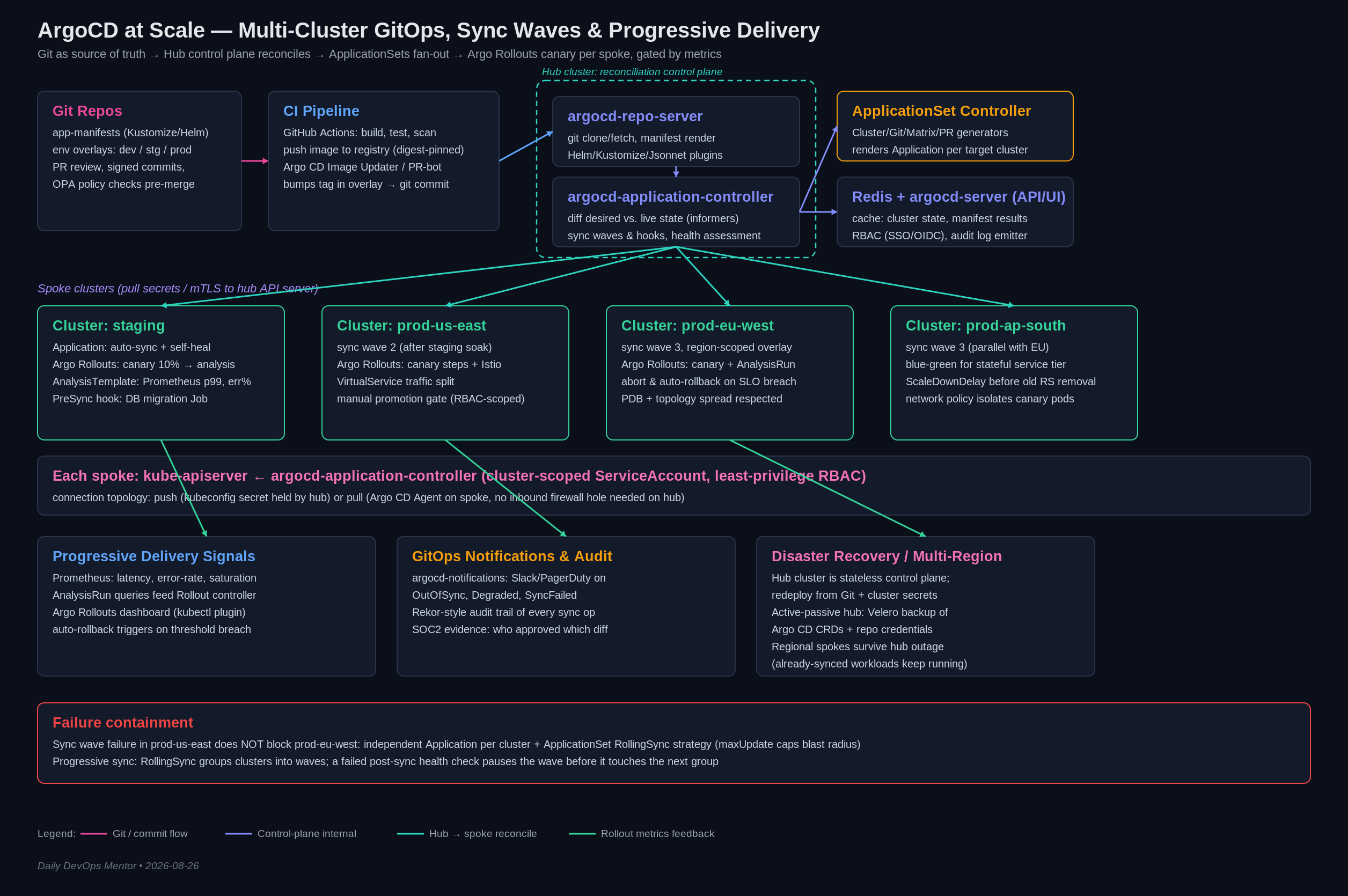
Topology decision: hub-and-spoke, not per-cluster Argo CD. A single hub cluster runs the full Argo CD control plane (argocd-server, argocd-repo-server, argocd-application-controller, argocd-applicationset-controller, Redis, Dex/SSO). Every spoke cluster is registered as a remote target via a cluster Secret holding either a kubeconfig (push model) or, as of the 2025–2026 Argo CD Agent work, a lightweight in-cluster agent that establishes an outbound connection to the hub (pull model, no inbound firewall rule required on spokes). This is the standard shape used by every large Argo CD deployment I'm aware of, because it centralizes RBAC, audit, and the Git-to-cluster mapping in one place instead of fragmenting policy across N independent control planes.
Component interactions and data flow.
- A developer merges to an environment-overlay branch/path (Kustomize overlays or Helm values per env). CI (GitHub Actions in most 2026 shops, per the CNCF adoption numbers above) builds, tests, scans, and pushes an image pinned by digest — never by mutable tag — to the registry.
- Argo CD Image Updater (or a PR-bot pattern) writes the new digest back into the Git overlay as a commit. Git, not the registry, is still the trigger — this preserves the audit trail and keeps rollback as simple as
git revert. argocd-repo-serverclones/fetches the repo, renders manifests (Helm/Kustomize/Jsonnet plugins), and hands rendered YAML to theapplication-controller.argocd-application-controllerruns the reconciliation loop: watch the target cluster via informers, diff live vs. desired, compute a sync plan respectingsync-waveandsync-hookannotations, and apply.ApplicationSetcontroller is the fan-out layer: aClusterGenerator(orGit,Matrix,PullRequest,Plugingenerator) renders oneApplicationper target cluster from a single template, so adding a 16th spoke cluster means adding one entry to a generator, not hand-writing anApplicationmanifest.- Each rendered
Applicationsyncs into its target spoke'skube-apiserverusing a cluster-scopedServiceAccountwith least-privilege RBAC — never cluster-admin, ever, for tenant-facing GitOps. - Post-sync, Argo Rollouts takes over health semantics for workloads using progressive delivery: a
Rolloutobject replaces the bareDeployment, canary or blue-green steps execute, andAnalysisRuns query Prometheus (or Datadog/CloudWatch) to decide promote vs. abort — this is the piece that answers "is it actually healthy," which plainSync: Succeededcannot.
Security boundaries. The hub's application-controller service account per spoke is scoped to only the namespaces/resource kinds that Application manages (enforced via resource inclusion/exclusion in argocd-cm plus spoke-side RBAC on the ServiceAccount Argo CD authenticates as). Git repo credentials, registry pull secrets, and cluster credentials are stored via the External Secrets Operator pattern, not raw Kubernetes Secrets committed anywhere — even encrypted ones sitting in the Argo CD namespace are a lateral-movement target if the hub is compromised, since that namespace effectively holds keys to every fleet cluster.
Networking. Hub-to-spoke traffic is either outbound-only from spokes (agent/pull model — strongly preferred for spokes in restrictive network zones or across cloud accounts) or hub-initiated over a private link/VPN mesh (push model — simpler operationally, worse blast radius if the hub is breached). Multi-cloud fleets (AWS + Azure, per the brief's hybrid/multi-cloud emphasis) almost always end up on the pull/agent model specifically to avoid punching holes through cloud-boundary firewalls for every spoke.
HA and DR. The hub is intentionally kept close to stateless: Redis is the only stateful component (cache, not source of truth), and it runs as a 3-node HA setup (Sentinel or a managed Redis). If the hub cluster is lost entirely, recovery is: stand up a new hub, restore the argocd-cm/argocd-secret/Application/ApplicationSet CRDs from Velero backup (or, better, keep those CRDs themselves GitOps'd into a bootstrap repo — "app of apps" recovering itself), re-register spoke cluster credentials, and let reconciliation resume. Critically: spokes keep running unaffected during a hub outage — the hub going down means you lose the ability to change things, not that already-synced workloads stop serving traffic. That property is why hub-and-spoke tolerates single-region hub placement for many orgs; the counter-argument (active-passive hub in two regions with Velero-based failover) buys faster recovery of change velocity at the cost of a second control plane to operate.
Multi-cloud consideration. Nothing about this design is cloud-specific — the hub can run on EKS while spokes run on AKS, GKE, or on-prem; the agent/pull model was built precisely to make heterogeneous, multi-cloud fleets tractable without a VPN mesh spanning every cloud account.
How it evolves at scale. Past a few thousand Application objects behind one hub, you shard: multiple hub instances, each owning a subset of spokes (by region, business unit, or blast-radius domain), fronted by a thin abstraction (or just documented ownership) so engineers know which hub owns which cluster. This trades a single pane of glass for reconciliation throughput and blast-radius isolation — covered in depth in section 9.
4. Solution Design
Design decision: ApplicationSet + RollingSync over hand-rolled per-cluster Applications. The alternative — one Argo CD Application YAML file per service per cluster, committed by hand or via a templating script outside Argo CD — is what most teams start with and what breaks first. At 15 clusters × 40 services, that's 600 manifests to keep consistent. ApplicationSet with a ClusterGenerator collapses that to one template; strategy: RollingSync adds progressive multi-cluster rollout (wave 1: canary/staging cluster, wave 2: one production region, wave 3: remaining regions in parallel), with maxUpdate capping how many clusters update concurrently per wave and automatic pausing if a wave's health check fails.
Alternative: push-based CD scripts extended from CI (Jenkins/GitHub Actions running kubectl apply or helm upgrade directly). Pros: no second system to operate, deploys feel synchronous and easy to reason about in a pipeline log. Cons — and this is the crux of why GitOps won at scale: no continuous drift correction (a manual change or a bad automated remediation just sits there until the next pipeline run), no single object representing "what's actually deployed where" for audit, and credentials for every target cluster have to live in CI, multiplying the blast radius of a CI compromise across every cluster CI can reach. This is precisely the anti-pattern current ArgoCD best-practice guidance (2026) warns against: "do not sync from CI and also have auto-sync enabled" — the two control loops race and produce non-deterministic apply order.
Alternative: Flux instead of Argo CD. Flux is source-driven (git push triggers reconciliation via notification-controller webhooks or polling) versus Argo CD's controller-driven pull loop with a UI-first operational model. Flux tends to win on being more Kubernetes-native (everything is a CRD, no separate UI/API server to run) and slightly lower resource footprint at small scale; Argo CD tends to win on operator UX (diff visualization, manual sync/rollback from a UI, RBAC mapped to human teams) and on the richness of the ApplicationSet multi-cluster fan-out model. Most large orgs standardizing on one tool pick Argo CD specifically because of the UI-driven operability story when the audience is hundreds of engineers, not just the platform team.
Scalability considerations. Reconciliation throughput is bounded by three knobs: application-controller replica count and per-replica --status-processors/--operation-processors concurrency, repo-server replica count (manifest rendering is CPU-bound and embarrassingly parallel, so this scales horizontally cleanly), and Kubernetes API server rate limits on each spoke (client-side QPS/burst settings in the controller's per-cluster REST config — the default is often too low for clusters with thousands of objects). Sharding controllers by cluster label (argocd.argoproj.io/... sharding, available natively since Argo CD 2.x) is the standard lever once one controller replica can't keep up.
Cost implications. The hub's repo-server and application-controller are the main cost centers — CPU-heavy at manifest-render and diff time, memory-heavy proportional to the number of live Kubernetes objects being watched across all spokes. Sizing mistakes here (undersized hub, resources.requests set too low) are the single most common cause of the OOMKill/rate-limit death spiral described in section 2. Spoke-side cost is negligible — Argo CD's footprint per spoke is just the ServiceAccount/RBAC and, in the agent model, one lightweight pod.
Security implications. The hub namespace holding cluster credentials for every spoke is a single point of compromise for the entire fleet — treat argocd namespace RBAC with the same rigor as a CI/CD secrets vault, enforce OIDC SSO (not local admin accounts) for the UI/API, and audit every sync/override/delete operation (Argo CD emits Kubernetes Events and supports webhook notifications for exactly this).
Performance implications. Sync-wave ordering (argocd.argoproj.io/sync-wave annotation) determines apply sequence within an Application, but does not by itself bound how long a hung wave blocks downstream resources — a PreSync hook Job that never completes will stall the whole Application indefinitely unless you set activeDeadlineSeconds on the hook Job and configure Argo CD's operation timeout.
5. Deep Technical Walkthrough
Internal working of the reconciliation loop. application-controller maintains a cache.SharedInformer-backed cluster cache per registered cluster (built on gitops-engine, the shared library Argo CD and Flux-adjacent tools both derive reconciliation primitives from). On a timer (default: every 3 minutes, or immediately on a Git webhook) it:
- Fetches the desired manifests from
repo-server(which itself may hit a Redis-backed manifest cache to avoid re-rendering unchanged Helm charts). - Diffs desired vs. the informer cache's live view using
kubectl-style structured diffing (respecting server-side apply field ownership where configured). - Computes
health.lua-based health status per resource kind — this is why "Synced" and "Healthy" are orthogonal: aDeploymentcan sync its spec successfully while its Pods crash-loop, leaving the ApplicationSyncedbutDegraded. - If out-of-sync and auto-sync is enabled (and not manually paused), executes the sync: runs
PreSynchooks, applies resources insync-waveorder (lowest number first, resources in the same wave applied together), runsPostSynchooks, and updates the operation state.
Request flow for a UI-triggered manual sync: browser → argocd-server (gRPC-Web) → application-controller operation queue → repo-server render (cache hit/miss) → spoke kube-apiserver apply → informer observes the change → controller re-diffs → status pushed back to argocd-server → UI streams the update over the same gRPC-Web connection. The entire path is why repo-server and application-controller CPU/memory directly gate UI responsiveness — a starved repo-server doesn't just slow syncs, it makes the UI feel broken because every page load re-renders diffs.
Control plane vs. data plane. Argo CD is the control plane for "what should be running." Argo Rollouts is a second control loop that owns the data-plane-facing question of "is the new version safe to keep." A Rollout resource behaves like a Deployment but pauses between steps, and an AnalysisRun polls a metrics provider (Prometheus query, Datadog, CloudWatch, Wavefront, or a custom Job-based provider) on an interval, comparing results against successCondition/failureCondition expressions. On failure, Rollouts can automatically execute abort (scale down canary, restore stable ReplicaSet) without any Argo CD involvement — sync-level success and rollout-level success are deliberately decoupled so a bad canary doesn't need a Git revert to remediate, just time (or a manual kubectl argo rollouts abort).
Failure scenarios and recovery mechanisms:
- Repo-server render timeout on a huge Helm chart: manifest generation exceeds the controller's operation timeout → sync marked
Error→ controller retries with backoff (retry.limit,retry.backoffin the sync policy). Recovery: split oversized charts, enable repo-server manifest caching, scale repo-server replicas. - Partial sync-wave failure: wave 2's Job hook fails → controller halts, does not proceed to wave 3 → Application shows
Degraded. This is correct behavior, not a bug — it's the containment mechanism. Recovery requires human or automated remediation of the failing hook, then either a retry or aTerminate+ resync. - Cluster cache desync from API server rate limiting: informers get
429s from a spoke'skube-apiserver, cache falls behind, controller's live-state view goes stale, and it may reportOutOfSyncfor resources that are actually fine (or worse, attempt to "correct" state that already matches). Recovery: raise spoke-side API priority & fairness (FlowSchema/PriorityLevelConfiguration) for the Argo CD ServiceAccount, and raise client-side QPS/burst on the controller's REST config for that cluster. - Hub
application-controllerOOMKill under fleet-wide load: controller restarts, cache is rebuilt from scratch (a full relist against every registered cluster), which itself spikes API server load across the entire fleet simultaneously — a self-inflicted thundering herd. Recovery: right-size controller memory with headroom above steady-state cache size, and consider sharding before you hit this ceiling rather than after.
Scaling behavior. Reconciliation cost scales roughly with (number of live Kubernetes objects across all watched clusters) × (diff frequency), not with the number of Application CRDs directly — a Deployment with a busy HPA generating constant Pod churn is far more expensive to watch than ten idle ConfigMaps. This is the number platform teams should actually track, not "Application count," when deciding when to shard.
6. Production Troubleshooting
Scenario: the Friday incident from section 2 — Applications stuck Progressing, some SyncFailed, UI showing stale health.
Symptoms observed:
- Argo CD UI: several Applications spinning in "Progressing" with no state change for 20+ minutes.
argocd_app_reconcile_countandargocd_app_reconcile_bucket(Prometheus metrics Argo CD exports) show reconcile latency p99 spiking from ~2s to 90s+.kubectl -n argocd top podsshowsargocd-repo-serverat memory limit, restarting.- Spoke cluster's
kube-apiserveraudit log / metrics show a burst of429 Too Many Requestsresponses to the Argo CD ServiceAccount identity around the same timestamp.
Step-by-step RCA, the way a senior platform engineer actually walks it:
- Check the operation state first, not the UI spinner.
argocd app get <name> -o json | jq '.status.operationState'— this tells you whether the controller thinks it's still applying, waiting on a hook, or has actually errored and the UI just hasn't refreshed. - Pull controller logs filtered to the affected Application:
kubectl -n argocd logs deploy/argocd-application-controller | grep <app-name>— look specifically forrpc error,context deadline exceeded, orclient rate limiter Wait returned an error, all of which point at spoke-side throttling rather than a manifest problem. - Check
repo-serverresource pressure:kubectl -n argocd describe pod -l app.kubernetes.io/name=argocd-repo-server— OOMKilled events here explain stalled rendering upstream of the sync itself, which will masquerade as "stuck syncs" even though the real bottleneck is manifest generation, not apply. - Correlate with the Prometheus dashboards:
argocd_app_reconcile_bucket(reconciliation latency histogram),argocd_cluster_api_resource_objects(cache size per cluster — did this cluster's object count spike recently, e.g., from a runaway CronJob?), andworkqueue_depthfor the controller's internal work queue — a growing queue depth confirms the controller is falling behind, not just slow on one Application. - Check spoke API server flow-control metrics:
apiserver_flowcontrol_rejected_requests_totalon the spoke, labeled byflowSchema— if the Argo CD ServiceAccount's requests are landing in a low-priorityFlowSchema(or the catch-all) and getting rejected under load, that's your root cause, not Argo CD itself. - Root cause, this incident: the shared Helm chart bump touched a
values.yamldefault that fanned out to 40Applicationsre-rendering simultaneously;repo-server(2 replicas, no manifest cache configured) OOM'd under the concurrent render load; controller's retry storm againstrepo-servercompounded the same-second load on spoke API servers as the backlog cleared all at once.
Config changes applied:
# argocd-cmd-params-cm: raise repo-server manifest cache and give it real headroom
data:
  reposerver.parallelism.limit: "20"
  server.repo.server.timeout.seconds: "90"
# repo-server Deployment: right-sized resources + more replicas, cache enabled
resources:
  requests: { cpu: "1", memory: "2Gi" }
  limits: { cpu: "2", memory: "4Gi" }
---
# argocd-cm: enable manifest generation caching (Redis-backed)
data:
  # reduces re-render cost for unchanged charts on repeated reconciliation
  application.resourceTrackingMethod: annotation
# spoke cluster: dedicate a FlowSchema/PriorityLevel so Argo CD never starves behind noisy tenants
apiVersion: flowcontrol.apiserver.k8s.io/v1
kind: FlowSchema
metadata:
  name: argocd-controller
spec:
  priorityLevelConfiguration: { name: workload-high }
  matchingPrecedence: 500
  rules:
  - subjects:
    - kind: ServiceAccount
      serviceAccount: { name: argocd-manager, namespace: kube-system }
    resourceRules:
    - apiGroups: ["*"]
      resources: ["*"]
      verbs: ["*"]
- Validate: watch
argocd_app_reconcile_bucketp99 return to baseline, confirm all 40 Applications reachSynced/Healthy, and re-run the same chart bump against a synthetic 40-app test set in staging before calling it closed.
This is exactly the systematic, metrics-first approach senior SREs use instead of guessing — sync failures have "dozens of different root causes," so the discipline is checking operation state → controller logs → resource pressure → API-server-side signals, in that order, rather than restarting pods and hoping.
7. Hands-on Lab
Goal: stand up a local hub + simulated multi-cluster fan-out with ApplicationSet and RollingSync, and observe a deliberately induced sync failure and its containment.
# 1. Local multi-cluster with kind (hub + 2 "spokes" as separate kind clusters)
kind create cluster --name hub
kind create cluster --name spoke-staging
kind create cluster --name spoke-prod

# 2. Install Argo CD on the hub
kubectl config use-context kind-hub
kubectl create namespace argocd
kubectl apply -n argocd -f https://raw.githubusercontent.com/argoproj/argo-cd/stable/manifests/install.yaml

# 3. Install Argo Rollouts controller + kubectl plugin (for progressive delivery)
kubectl create namespace argo-rollouts
kubectl apply -n argo-rollouts -f https://github.com/argoproj/argo-rollouts/releases/latest/download/install.yaml
curl -LO https://github.com/argoproj/argo-rollouts/releases/latest/download/kubectl-argo-rollouts-linux-amd64
chmod +x kubectl-argo-rollouts-linux-amd64 && sudo mv kubectl-argo-rollouts-linux-amd64 /usr/local/bin/kubectl-argo-rollouts

# 4. Register the two spoke clusters with Argo CD (run from the hub context)
kubectl config use-context kind-hub
argocd cluster add kind-spoke-staging --name staging -y
argocd cluster add kind-spoke-prod --name prod -y

# 5. Define an ApplicationSet fanning a demo app out to both spokes with a rolling strategy
cat <<'EOF' | kubectl apply -f -
apiVersion: argoproj.io/v1alpha1
kind: ApplicationSet
metadata:
  name: demo-fanout
  namespace: argocd
spec:
  strategy:
    type: RollingSync
    rollingSync:
      steps:
      - matchExpressions: [{ key: envtype, operator: In, values: [staging] }]
        maxUpdate: "100%"
      - matchExpressions: [{ key: envtype, operator: In, values: [prod] }]
        maxUpdate: "50%"
  generators:
  - clusters:
      selector:
        matchLabels: {}
  template:
    metadata:
      name: 'demo-{{name}}'
    spec:
      project: default
      source:
        repoURL: https://github.com/argoproj/argocd-example-apps.git
        targetRevision: HEAD
        path: guestbook
      destination:
        server: '{{server}}'
        namespace: demo
      syncPolicy:
        automated: { selfHeal: true, prune: true }
        syncOptions: [CreateNamespace=true]
EOF

# 6. Induce a failure: point the prod spoke's destination namespace RBAC to deny create,
#    forcing a SyncFailed, and confirm staging still reaches Healthy independently
kubectl --context kind-spoke-prod create clusterrolebinding block-demo --clusterrole=view \
  --serviceaccount=kube-system:argocd-manager --dry-run=client -o yaml | \
  kubectl --context kind-spoke-prod apply -f -   # intentionally under-privileged

argocd app get demo-staging   # expect Synced / Healthy
argocd app get demo-prod      # expect SyncFailed — RollingSync should NOT have advanced past staging
Validation: confirm demo-staging is Synced/Healthy while demo-prod sits SyncFailed, and that the ApplicationSet status shows the rolling strategy paused rather than having force-advanced — this is the blast-radius containment behavior from section 3 working as designed.
Cleanup:
argocd app delete demo-staging demo-prod --cascade -y
kubectl delete applicationset demo-fanout -n argocd
kind delete clusters hub spoke-staging spoke-prod
8. Production Case Study
Intuit, Argo's originator, runs Argo CD internally across its own large multi-tenant Kubernetes estate and has published details on evolving the gitops-engine reconciliation core specifically to handle sharding and cache efficiency at the scale of thousands of Applications — the sharding-by-cluster-label mechanism referenced in section 4 exists because Intuit's own fleet outgrew a single controller replica.
Red Hat (OpenShift GitOps) packages Argo CD as the default GitOps layer for OpenShift and documents Argo Rollouts as the sanctioned progressive-delivery mechanism for customers running canary/blue-green on top — validating the pairing this session covers (Argo CD for "what's deployed," Argo Rollouts for "is it safe") as the production-recommended combination rather than a niche pattern.
Netflix and Uber, while not both standardized on Argo CD specifically, popularized the underlying pattern this entire session rests on: canary analysis driven by automated metrics comparison rather than human judgment (Netflix's Kayenta project was an early, influential implementation of exactly the automated-analysis idea Argo Rollouts' AnalysisRun operationalizes as a first-class Kubernetes CRD). The broader industry lesson these companies converged on independently: progressive delivery only earns its keep once the promotion/rollback decision is driven by a metrics query instead of a human staring at a dashboard, because humans don't reliably catch a 2% error-rate regression on a five-minute canary window at 2 a.m.
Common thread across all of these at scale: none of them treat "sync succeeded" as the finish line. Every mature GitOps-at-scale organization decouples reconciliation success (Argo CD's job) from rollout safety (Argo Rollouts' job or an equivalent), because conflating them is exactly what produces the "green sync, broken prod" incidents that erode trust in GitOps as a practice.
9. Architecture Review
Strengths. Hub-and-spoke centralizes RBAC, audit, and credential management in one place instead of N fragmented control planes; ApplicationSet + RollingSync turns fleet-wide changes from a hand-rolled scripting problem into a declarative wave strategy with automatic pause-on-failure; decoupling Argo CD (desired-state reconciliation) from Argo Rollouts (rollout safety) means a bad deploy can self-heal (abort + rollback) without needing a human to revert Git.
Weaknesses. The hub is a single control-plane blast radius for the entire fleet's ability to change — not runtime availability, but change velocity — during an outage; repo-server/application-controller sizing is a persistent operational tax that doesn't show up until you're already in the failure mode from section 2; and RBAC/credential sprawl in the argocd namespace (one namespace holding effective access to every spoke) is a concentrated target that most teams under-invest in relative to its blast radius.
What fails first at 10x scale. Reconciliation throughput on a single unsharded application-controller — the informer cache size and diff frequency scale with total watched objects across the fleet, and at 10x today's cluster/object count, one controller replica hits CPU/memory/API-rate-limit ceilings well before anything else in the architecture does. The second thing to fail is repo-server render concurrency if manifest caching wasn't enabled early, exactly as happened in the section-6 incident but permanently rather than as a one-off spike.
What changes for 100 million end users. At that scale you're not running one Argo CD fleet, you're running several, sharded by business domain or blast-radius boundary (payments, core platform, ML infra as separate hub instances rather than one mega-hub), each independently sized and independently on-called, with a thin cross-cutting layer (a Backstage-style catalog, per the emerging-technologies list) giving engineers one place to find "which hub owns my cluster" without forcing operational coupling between domains that don't need it.
What I'd redesign. Bake manifest-generation caching and repo-server autoscaling (HPA on CPU, not just static replica counts) into the default install from day one rather than as a reactive fix after the first fleet-wide incident — the section 6 RCA is common enough across the industry that it shouldn't be a rite of passage. I'd also push harder, earlier, on the agent/pull connectivity model over kubeconfig-secret push, specifically because it removes the "hub holds live credentials to every spoke" property that makes the argocd namespace such a high-value target.
10. Best Practices
Reliability. Enable selfHeal deliberately, not by default everywhere — for stateful or migration-heavy Applications, uncontrolled self-heal can fight with legitimate manual remediation during an incident; scope it per-Application based on blast radius. Always set retry.limit and exponential backoff on sync policies so transient API server hiccups don't require manual re-sync.
Scalability. Shard application-controller by cluster label before you're forced to, and track argocd_cluster_api_resource_objects as your leading indicator, not Application count. Enable repo-server manifest caching and give it real CPU headroom — it's the cheapest fix with the highest incident-prevention value from this entire session.
Observability. Scrape and alert on argocd_app_reconcile_bucket (p99 reconcile latency), workqueue_depth, and argocd_app_sync_total{phase=Failed} — these three catch the section-6 failure mode well before the UI "looks" broken to an end user.
Security. OIDC SSO for every human accessing the UI/API, never local admin passwords in production; least-privilege per-spoke RBAC for the Argo CD ServiceAccount, scoped to only the namespaces/kinds each Application actually manages; External Secrets Operator (or equivalent) for cluster credentials and repo tokens, never raw committed Secrets.
Cost optimization. Right-size repo-server/application-controller once, based on real fleet object counts, instead of iteratively firefighting OOMKills — the compute cost of correctly-sized control-plane pods is trivial next to the incident cost of an under-sized one during a fleet-wide change.
Performance. Set activeDeadlineSeconds on every PreSync/PostSync hook Job — an unbounded hook is the single most common cause of an Application silently stuck Progressing forever.
Maintainability. Standardize on ApplicationSet generators over hand-authored per-cluster Application YAML from day one, even for small fleets — retrofitting this after 40 hand-written manifests exist is significantly more painful than starting with it.
Operational excellence. Practice the RollingSync pause/resume and manual promotion-gate flows in staging before the first real fleet-wide incident forces the team to learn them live — build muscle memory in non-production before touching production, per current field guidance.
11. Common Production Mistakes
Syncing from both CI and Argo CD auto-sync simultaneously. This creates a race between two independent control loops applying the same resources, producing non-deterministic apply order and phantom OutOfSync flapping. Fix: CI's only job is to update the image tag/digest in Git; Argo CD owns every actual apply.
Treating Synced as equivalent to "deployed successfully." As covered in section 5, sync and health are orthogonal state machines. Teams that gate release sign-off on sync status alone (instead of Rollout/AnalysisRun health) ship regressions that "technically deployed fine."
No activeDeadlineSeconds on hook Jobs. A hung database-migration PreSync hook blocks the entire Application indefinitely with no automatic timeout, and the on-call has no signal beyond "it's been Progressing for an hour" to go on.
Granting cluster-admin to the Argo CD ServiceAccount "to avoid RBAC headaches." This turns the hub's argocd namespace into a skeleton key for the entire fleet — exactly the concentrated blast radius flagged in section 9 as a weakness, made worse rather than mitigated.
Running one unsharded application-controller replica well past the point where fleet object count demands sharding. Teams delay sharding because it feels like premature complexity, then hit the OOMKill/rate-limit spiral from section 6 in production instead of as a planned migration.
Skipping the health-check wait in CI-driven promotion gates. A successful sync is not a successful deployment; any pipeline step that proceeds immediately after argocd app sync without waiting on argocd app wait --health is racing against Pods that haven't started yet.
12. Interview Preparation
Q: Walk me through what happens, end to end, when a sync fails partway through a multi-wave Application. A: The controller applies resources wave-by-wave in ascending sync-wave order; if a wave's hook or resource apply fails, the controller halts and does not proceed to subsequent waves — this is intentional containment, not a bug. The Application surfaces as Degraded/SyncFailed, and recovery requires either fixing the failing resource and manually re-triggering, or (if retry is configured) automatic backoff-based retry. Earlier waves that already succeeded remain applied; the controller doesn't roll them back automatically unless the sync policy is configured to do so.
Q: How do you decide when to shard the application-controller? A: Track argocd_cluster_api_resource_objects (total watched object count across the fleet) and workqueue_depth/reconcile-latency p99 as leading indicators, not Application count — a handful of Applications managing tens of thousands of churny objects (busy HPAs, CronJobs) is more expensive than hundreds of nearly-static ones. Shard by cluster label once controller CPU/memory or reconcile latency trends toward your SLO ceiling, before you're forced into it during an incident.
Q: What's the actual difference between Argo CD and Argo Rollouts, and why do you need both? A: Argo CD reconciles desired state from Git into the cluster and answers "is the object I declared actually present and matching." Argo Rollouts owns progressive delivery and answers "is the new version of that object actually safe to keep," using metrics-driven AnalysisRuns to gate canary/blue-green promotion and auto-rollback. Argo CD alone has no concept of gradual traffic shifting or automated abort-on-regression; Rollouts alone has no concept of Git-based desired state. They compose: Argo CD manages the Rollout object like any other resource, Rollouts drives what happens to Pods/traffic underneath it.
Q: Design a multi-region GitOps rollout strategy that limits blast radius. A: ApplicationSet with RollingSync, grouping spoke clusters into waves (e.g., staging → one production region as canary → remaining regions in parallel), maxUpdate capping concurrent updates per wave, and a failed post-sync health check in one wave halting progression to the next — combined with Argo Rollouts canary steps within each cluster so a bad version can't even fully land in one region before its own AnalysisRun catches it. Blast radius is bounded at two levels: cross-cluster (wave gating) and within-cluster (canary percentage).
Q: A spoke cluster starts returning 429s to the Argo CD controller. What's your triage? A: Check spoke-side API Priority & Fairness metrics (apiserver_flowcontrol_rejected_requests_total) to see if the Argo CD ServiceAccount is landing in an under-provisioned FlowSchema; check whether total watched object count on that cluster spiked recently (a runaway CronJob or HPA); raise client-side QPS/burst on the controller's per-cluster REST config as a stopgap while addressing the root cause (dedicated FlowSchema/PriorityLevel for the Argo CD identity) as the durable fix.
Q: Why is cluster-admin for the Argo CD ServiceAccount a bad default, and what's the alternative? A: It turns one credential (held in the hub's argocd namespace) into a skeleton key for the entire target cluster, so a hub compromise or an RBAC misconfiguration in one Application's manifests has fleet-wide blast radius instead of being contained to the namespaces/kinds that Application legitimately manages. The alternative is least-privilege RBAC scoped via resource inclusion/exclusion in argocd-cm plus a spoke-side ClusterRole limited to the actual managed resource kinds and namespaces.
13. Latest Industry Updates
- Argo CD 3.5 (released 4 Aug 2026, latest patch 3.5.1 on 12 Aug 2026) is the current stable line, with 3.4.x and 3.3.x still under support per the project's four-minor-releases-per-year, three-supported-versions policy — platform teams should track this cadence deliberately since RBAC and API surface changes have landed across recent majors (3.0 brought leaner memory usage and expanded RBAC). (endoflife.date/argo-cd)
- ApplicationSet progressive/RollingSync patterns matured through 2026 as the standard approach for wave-based multi-cluster rollout, with the community converging on a "two-level blast-radius model" — cluster-level gating via
ApplicationSetwaves, pod-level gating via Argo Rollouts steps — as the reference architecture for large fleets. (codingprotocols.com) - Cross-project orchestration efforts (e.g., pairing Argo CD's declarative application model with dedicated multi-cluster schedulers like Karmada for propagation/override policy) are an active area of 2026 conference content, reflecting that pure
ApplicationSetfan-out still leaves higher-level traffic/placement orchestration as an open problem for the most complex fleets. (tldrecap.tech — ArgoCon Europe 2026 sessions) - ArgoCon returns as a co-located CNCF event at KubeCon + CloudNativeCon North America 2026 (Nov 9), with an added AI Inference + Agentic track at the main event — a signal that GitOps and progressive-delivery patterns are increasingly being pulled into the AI-serving deployment story (canary-rolling a new model version is mechanically the same problem as canary-rolling a service). (cncf.io)
- Why this matters in production: the version-support window shrinking to three minors means upgrade cadence has to be an active platform-team process, not an occasional catch-up project — falling two majors behind on a fleet-critical control plane like Argo CD means losing security patches on a system that holds credentials to every cluster you run.
14. Summary & Cheat Sheet
Key concepts. GitOps = Git as source of truth, controller-driven continuous reconciliation (not one-shot kubectl apply). Argo CD owns desired-state reconciliation; Argo Rollouts owns progressive-delivery safety — Synced and Healthy are orthogonal, don't conflate them.
Architecture. Hub-and-spoke: one control plane, N registered clusters via kubeconfig-secret (push) or Argo CD Agent (pull, preferred for multi-cloud/restrictive networks). ApplicationSet + RollingSync for wave-gated multi-cluster fan-out; least-privilege per-spoke RBAC, never cluster-admin.
Commands:
argocd app get <app> -o json | jq '.status.operationState'   # real sync state, not UI spinner
argocd app wait <app> --health                                 # block until actually healthy, not just synced
argocd app sync <app> --retry-limit 5                           # manual sync with retry
kubectl argo rollouts get rollout <name> --watch                # live canary/blue-green status
kubectl argo rollouts promote <name>                            # advance a paused canary step
kubectl argo rollouts abort <name>                               # immediate rollback to stable
Best practices checklist.
- CI writes to Git only; Argo CD is the sole applier — never both auto-syncing the same target.
activeDeadlineSecondson every hook Job. No exceptions.- Manifest caching + right-sized
repo-server/application-controllerfrom day one. - Shard controllers by watched-object count, not Application count.
- OIDC SSO, least-privilege spoke RBAC, secrets via ESO — not raw committed Secrets.
- Gate promotion on Rollout/AnalysisRun health, never on sync status alone.
Troubleshooting checklist (in order).
operationState, not the UI spinner.- Controller logs filtered to the Application — look for rate-limiter/context-deadline errors.
repo-serverresource pressure (OOMKill events).argocd_app_reconcile_bucket,workqueue_depth,argocd_cluster_api_resource_objects.- Spoke-side
apiserver_flowcontrol_rejected_requests_totalby FlowSchema. - Fix root cause (cache, sizing, FlowSchema), validate, then load-test the same change pattern in staging before it happens again in prod.