
title: "Zero-Trust Workload Identity at Scale: SPIFFE, SPIRE, and the End of Long-Lived Service Credentials" date: 2026-09-23 tags: [SPIFFE, SPIRE, Zero Trust, Workload Identity, mTLS, Kubernetes, DevSecOps, Istio, Envoy, CNCF] cover: ../images/spiffe-spire-zero-trust-workload-identity-cover.png

Zero-Trust Workload Identity at Scale: SPIFFE, SPIRE, and the End of Long-Lived Service Credentials
1. Topic of the Day
Every previous post in this series that touched identity — IRSA and Azure Workload Identity, Istio's ambient mesh, Falco/Tetragon runtime security — quietly assumed the same thing: that a workload's identity is scoped to one cloud, one cluster, or one mesh. IRSA answers "which AWS role can this pod assume," and Azure Workload Identity answers the same question for Entra ID. Istio's Citadel answers "which mesh identity does this sidecar hold." Each of those is a good, narrow answer to a narrow question — and each one stops working the moment a workload needs to prove who it is to a system that doesn't trust that particular cloud's IAM or that particular mesh's control plane. A payments service running on EKS that needs to call a fraud-scoring service on a different team's on-prem OpenShift cluster, through a partner's API gateway, cannot present an AWS instance role, and it cannot present an Istio mTLS certificate issued by a control plane the other side has never heard of. It needs an identity that means the same thing everywhere: on bare metal, in a VM, in a container, in Kubernetes, in AWS, in Azure, in a colo the company has owned for a decade.
That is the specific, narrow problem SPIFFE (Secure Production Identity Framework for Everyone) exists to solve, and SPIRE (the SPIFFE Runtime Environment) is the production-grade reference implementation that issues those identities. SPIFFE is a specification, not a product: it defines the SPIFFE ID (a URI like spiffe://prod.example.com/ns/payments/sa/checkout), the SVID (SPIFFE Verifiable Identity Document — either a short-lived X.509 certificate or a signed JWT carrying that ID), and the Workload API (a local, authenticated gRPC socket a workload calls to fetch its own identity without ever touching a private key file on disk). SPIRE is the widely-deployed implementation of that spec: a server that acts as the certificate authority and policy engine, and an agent that runs on every node, cryptographically attests what's actually running there, and hands out SVIDs only to processes that match a registered, verified identity.
SPIFFE was accepted into the CNCF on March 29, 2018, moved to Incubating on June 22, 2020, and reached Graduated maturity on August 23, 2022 — the same tier as Kubernetes, Envoy, and Prometheus, and a tier above Crossplane, OpenTelemetry, and Backstage covered earlier in this series. By 2026 it underpins identity in Istio (Istiod's own CA is SPIFFE-compliant, and Istio can delegate to an external SPIRE deployment via Envoy's SDS API), is used in production at Uber, Bloomberg, Pinterest, GitHub, ByteDance, Twilio, Anthem, and Niantic, and has commercial distributions from Tetrate, HPE, and Otterize. It shows up wherever an organization has decided that mutual TLS between every workload, everywhere, with no long-lived static secret anywhere in the path is a requirement rather than an aspiration — which, for regulated industries and any company that has survived a secrets-leak incident, is an increasingly common conclusion.
The reason this belongs in the same category as this series' Kyverno/OPA policy post and its IRSA/Azure Workload Identity post, but is neither of them, is that SPIFFE/SPIRE solves workload-to-workload authentication independent of any single cloud or mesh vendor, while IRSA/Workload Identity solve workload-to-cloud-API authentication within one provider, and a service mesh's built-in mTLS solves identity only for workloads inside that mesh. Production platforms increasingly run all three side by side — and increasingly use SPIRE as the common root underneath both, federating SPIFFE identity into cloud IAM instead of maintaining three separate identity systems that don't know about each other.
2. Real Business Problem
Scenario: A financial-services platform runs roughly 900 services across three environments that grew up independently over eight years: an EKS fleet for newer services, a fleet of VMs running a mix of Ansible-managed Java monoliths that predate Kubernetes entirely, and an on-prem OpenShift cluster inherited from a 2023 acquisition that a compliance mandate prevents from migrating to the cloud for another eighteen months. A new PCI-DSS 4.0 audit finding requires "cryptographically verifiable mutual authentication between all services handling cardholder data, independent of network segmentation," and network segmentation is explicitly called out as insufficient on its own — the auditors have seen too many breaches that hopped a supposedly-isolated VLAN.
The investigation into current state finds a mess that's familiar in outline to every one of this series' identity-adjacent posts, but worse because it spans three infrastructure generations at once:
- Three incompatible identity systems, none of which talk to each other. EKS services use IRSA to reach AWS APIs but have no verifiable identity toward each other — service-to-service calls inside the VPC rely on network ACLs and a shared API key rotated quarterly. The VM fleet authenticates services to each other with mutual TLS certificates issued by an internal Microsoft CA with a 2-year validity period, hand-renewed via a ticket queue that averages 11 days turnaround — three services are currently running on certificates that expired and were only caught because a client started rejecting them. OpenShift uses its own internal service-account tokens, valid only inside that cluster.
- A literal secret sprawl audit finding. A grep-based secrets scan across the VM fleet's configuration management repository turns up 340 distinct static credentials — API keys, database passwords, and inter-service shared secrets — with no consistent rotation schedule; 60 of them have not been rotated in over three years, and nobody can produce a confident list of which services actually still use each one, because removing a credential nobody documented as unused has caused two outages in the past.
- Cross-environment calls are secured by network topology alone. The path from an EKS payment-processing pod to the OpenShift fraud-scoring service crosses a site-to-site VPN and is "secured" by the fact that only specific IP ranges are allowed through the firewall — exactly the segmentation-as-security-boundary pattern the audit finding calls insufficient. Anything on the allowed subnet, compromised or not, can call the fraud service.
- No way to answer "which specific workload made this call," only "which IP address." During a Sev-1 investigation into anomalous fraud-service traffic, the platform team's best evidence was a source IP inside a Kubernetes pod CIDR shared by 40 different deployments — narrowing "which service" down took correlating kubectl logs, load-balancer logs, and a lucky timestamp match, a 6-hour process that a workload-level identity in the access logs would have made instant.
- Certificate rotation for the VM fleet is a scheduled outage, not a background operation. Because renewal requires a human ticket and a manual reload, rotating the internal CA fleet-wide (last done after a different auditor flagged the 2-year validity as too long) took a coordinated 6-week rollout with three rollback incidents from services that didn't reload their in-memory certificate on SIGHUP correctly.
- The compliance mandate explicitly requires mTLS to survive a compromised network segment, which none of the three current identity systems do independently — IRSA doesn't cover service-to-service traffic at all, the VM CA's long-lived certs are a standing asset worth stealing, and OpenShift's tokens don't extend outside that cluster.
Leadership's mandate, driven directly by the audit finding with a hard remediation deadline: every service-to-service call handling cardholder data must be mutually authenticated with short-lived, cryptographically verifiable credentials, the identity must be meaningful and consistent across EKS, the VM fleet, and OpenShift, credential rotation must happen automatically with no human ticket in the loop, and every authenticated call must be attributable to a specific workload identity in the audit log — not an IP address, not a shared API key, not a service account name that four different deployments reuse.
3. Production Architecture
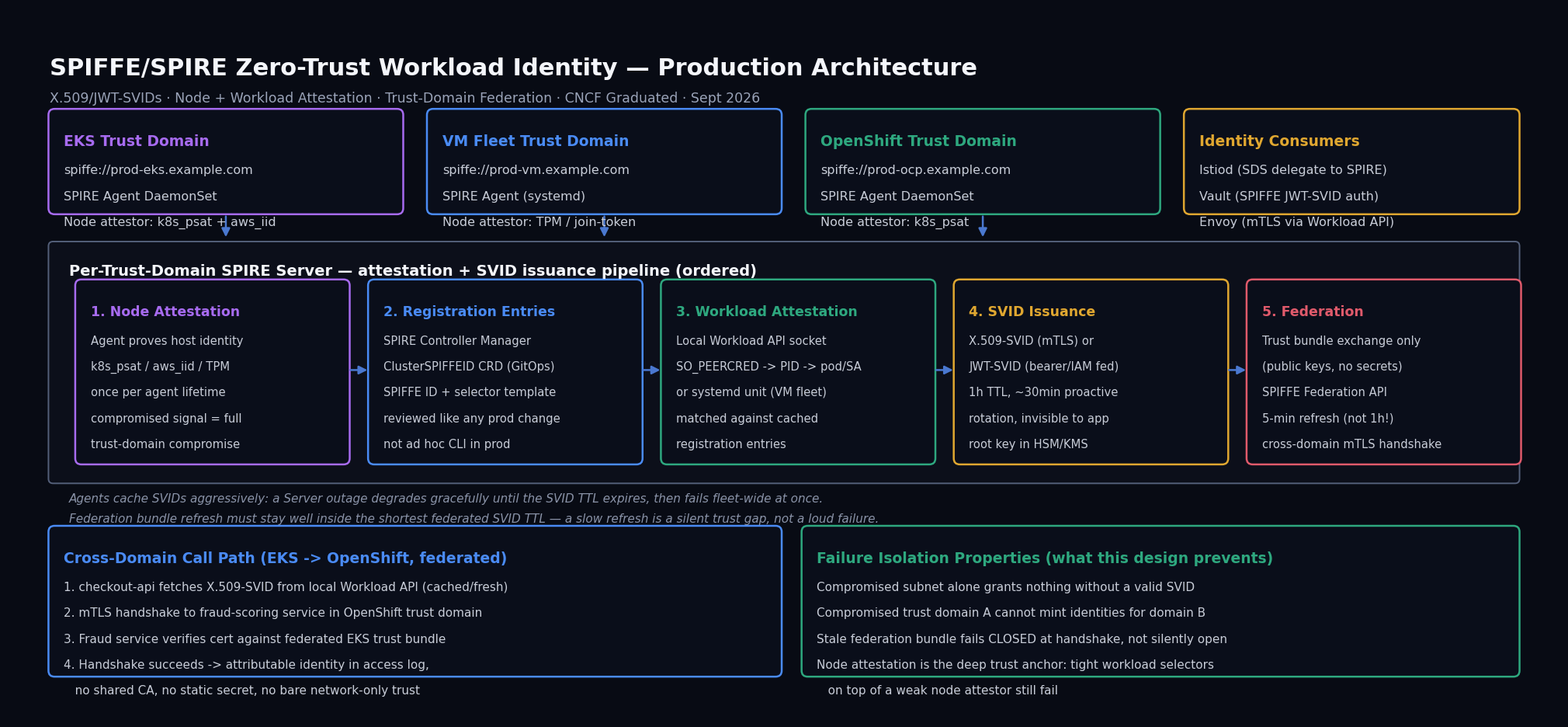
SPIRE Server is the certificate authority and the source of truth for the registration graph; it never talks directly to a workload. Every environment — the EKS fleet, the VM fleet, and OpenShift — runs its own SPIRE Server, each rooted in its own trust domain (spiffe://prod-eks.example.com, spiffe://prod-vm.example.com, spiffe://prod-ocp.example.com). This is a deliberate rejection of a single shared root CA across all three environments: a shared root means a compromise of the SPIRE Server in any one environment hands an attacker the ability to mint valid identities for every other environment's workloads too — the exact blast-radius expansion the SPIFFE community explicitly warns against. Each server persists its registration entries (which workload gets which SPIFFE ID, and by what attestation criteria) in its own datastore — Postgres in production, backed up and replicated the same way any other stateful control-plane component is.
SPIRE Agent runs on every node and is the only thing that ever touches the private key. In EKS, the agent runs as a DaemonSet; on the VM fleet, as a systemd service installed by the same configuration management that used to distribute the old shared secrets; in OpenShift, as a DaemonSet under a dedicated security context constraint. The agent's job is node attestation — proving to the SPIRE Server which physical or virtual host it's running on, using a platform-specific signal that can't be forged without compromising the platform itself: k8s_psat (a Kubernetes projected service account token bound to the node) in EKS and OpenShift, aws_iid (a signed AWS instance identity document, verified server-side against the AWS API) is available as a second layer in EKS, and a TPM-backed or join-token attestor for the VM fleet. Node attestation happens once per agent lifetime; it establishes that this specific node is who it claims to be, which is the foundation everything else stands on — a workload attestation on a node that lied about itself is worthless.
Workload attestation happens locally, on every single identity request, with zero network round-trip to prove "what am I." A workload calls the Workload API over a Unix domain socket (/run/spire/sockets/agent.sock) — no credentials, no token, nothing to steal, because the socket's permissions and the calling process's kernel-visible attributes (UID, GID, Kubernetes pod UID via the container runtime, systemd unit name) are the authentication. The agent inspects the caller through these OS/platform-native selectors, matches them against its cached registration entries, and — only on a match — returns a fresh SVID for that specific SPIFFE ID. This is the answer to the mandate's "attributable to a specific workload identity" requirement: a workload cannot lie about which pod, container, or systemd unit it's running as, because the agent is reading that fact from the kernel or the container runtime, not from anything the workload asserts about itself.
SVIDs are short-lived by design, and rotation is the agent's job, invisible to the workload. Default TTL is one hour, with the agent proactively rotating at roughly half that lifetime — so a workload's identity document is never more than 30 minutes old in steady state, and a compromised SVID is worthless within the hour even if nothing else happens. This directly answers the audit's "credential rotation must happen automatically" requirement: there is no ticket, no reload signal, no scheduled outage — a well-behaved client library (go-spiffe, java-spiffe, or the SPIFFE-aware transport built into Envoy/Istio) watches the Workload API stream and swaps the in-memory certificate transparently, the same way a browser doesn't notice a TLS session key rotating mid-connection.
Federation is what turns three separate trust domains into one verifiable identity fabric, without merging their CAs. Each SPIRE Server periodically publishes its trust bundle (its CA's public keys, nothing secret) via the SPIFFE Federation API, and each of the other two servers is configured to fetch and trust that bundle for its specific trust domain. A workload in the EKS trust domain calling the OpenShift fraud service presents an X.509-SVID signed by the EKS root; the fraud service, holding the OpenShift trust bundle plus the federated EKS bundle, verifies the SPIFFE ID cryptographically without ever needing a shared CA, a VPN-based network trust assumption, or a manually distributed certificate. This is the direct architectural answer to "secured by network topology alone" — the mutual TLS handshake itself proves identity, so a compromised subnet gains an attacker nothing without also compromising a specific workload's attested identity.
Why this design, and the trade-offs. The alternative seriously evaluated was extending the existing internal Microsoft CA fleet-wide and automating its renewal with a tool like cert-manager, rather than adopting a new framework. That path is real and legitimate for organizations with a single trust domain and a single certificate lifecycle to manage — cert-manager's Certificate CRD plus an ACME or Vault issuer solves automatic rotation well within one Kubernetes cluster. It was rejected here specifically because it doesn't solve workload attestation — cert-manager issues a certificate to whatever presents a valid CSR and passes its issuer's checks, but it has no native concept of "prove via the kernel that you are pod X in namespace Y," which is the exact gap that let the VM fleet's shared secrets go unrotated for three years with nobody able to say which service actually used them. SPIRE's attestation model costs real operational investment — running a SPIRE Server and its datastore per trust domain, writing and maintaining registration entries as code, and standing up federation between domains — but it means an identity is bound to a verified runtime fact, not merely to whoever asked nicely with a certificate signing request. As the platform scales past three trust domains toward a fourth (a planned GCP footprint for a new analytics product), the natural evolution is a federation mesh or a hub trust domain rather than pairwise federation between every pair of domains, which becomes O(n²) to reason about past four or five domains.
4. Solution Design
Design decision: one trust domain per environment/administrative boundary, federated rather than shared. This mirrors the guidance from the SPIFFE project itself and from every production case study reviewed: trust domains should align with who operates the SPIRE Server and who is accountable for its security, not with a logical grouping like "all payments services." The EKS, VM, and OpenShift environments have different operators, different patch cadences, and different blast-radius tolerance, so they get different trust domains, federated at the edges where cross-environment calls actually happen.
Alternative considered and rejected: HashiCorp Vault as the sole identity and secrets layer, using its PKI secrets engine and AppRole/Kubernetes auth instead of SPIRE. Vault is already deployed for static secret storage and was a serious contender, since its PKI engine can issue short-lived certificates too. It was rejected as the primary workload-identity mechanism specifically because Vault's authentication methods (AppRole, Kubernetes service-account JWTs) verify a credential the workload presents, not a runtime fact the platform observes — a stolen AppRole secret_id or a leaked Kubernetes token is still a bearer credential an attacker can replay from anywhere, whereas SPIRE's Workload API only ever hands an SVID to the process it locally, cryptographically attested as the registered workload. The organization kept Vault for what it's good at — application secrets, database credentials, encryption-as-a-service — and layered SPIRE underneath it: Vault's Kubernetes auth method itself now trusts SPIFFE-issued JWT-SVIDs rather than raw service-account tokens, so even Vault's own bearer-token weak point gets hardened by SPIRE sitting underneath it.
Alternative considered and rejected: solving this entirely inside Istio, using Istiod's built-in Citadel CA and skipping SPIRE. Istio ships SPIFFE-compliant identity out of the box and would have covered the EKS mesh traffic with materially less new infrastructure. Rejected as a complete solution because Istiod's CA has no jurisdiction over the VM fleet or OpenShift, which aren't in the mesh and, for the VM fleet's legacy Java monoliths, likely never will be — a sidecar-based mesh doesn't extend to a systemd service on a bare VM. The organization's actual choice was not "SPIRE instead of Istio" but "SPIRE underneath Istio": Istiod in the EKS trust domain is configured to delegate to the local SPIRE Server via Envoy's SDS API rather than using its own internal CA, so mesh workloads and non-mesh workloads in the same trust domain share one root of trust instead of two independent PKIs that both claim to speak SPIFFE but don't actually federate with each other.
Scalability considerations: registration entries, not raw workload count, are the dominant cost driver — SPIRE Server memory and CPU scale with the number of registration entries and the churn rate of workload attestation, not directly with request volume, since SVID issuance is a local agent-cache hit for any workload that isn't newly starting. Cost implications: three SPIRE Server deployments (one per trust domain, each HA with 3 replicas and a managed Postgres instance) plus federation bandwidth are a modest, mostly-fixed infrastructure cost against the alternative of a compliance failure and the standing risk of the 340-secret sprawl; the larger cost is engineering time writing registration entries as code and migrating the VM fleet's 200-odd legacy services one at a time. Security implications: the SPIRE Server's private signing key per trust domain becomes the single highest-value target in that domain — it must be backed by an HSM or a cloud KMS-backed upstream authority (SPIRE supports Vault, AWS ACM Private CA, and a raw KMS key as upstream authorities specifically so the server's own root key never sits as a bare file on disk) — a fact the design review in Section 9 returns to directly.
5. Deep Technical Walkthrough
The Workload API call, end to end. A workload's SPIFFE-aware client library dials the local Unix domain socket and opens a streaming gRPC call (FetchX509SVID or, for JWT identities, FetchJWTSVID). The agent, on receiving the connection, calls back into the OS to identify the calling process — on Linux, via SO_PEERCRED to get the PID, UID, and GID of the socket's peer — then walks up from that PID through the container runtime (containerd/CRI-O) to resolve which pod, namespace, and service account own that process, or, on the VM fleet, resolves the systemd unit that owns that PID. Those resolved facts become selectors (k8s:ns:payments, k8s:sa:checkout, k8s:pod-label:app:checkout-api, or unix:uid:1000, unix:path:/opt/app/checkout). The agent compares the selector set against its cached registration entries (synced from the server on an interval and on push notification, not fetched fresh per request) and, on a match, either returns an already-cached SVID or mints a fresh one via a signed request to the server.
Registration entries are the actual policy, and they are code, not clicks. A typical entry, created via spire-server entry create or, in production, via the SPIRE Controller Manager's ClusterSPIFFEID custom resource so registration lives in git next to the workload's other Kubernetes manifests:
apiVersion: spire.spiffe.io/v1alpha1
kind: ClusterSPIFFEID
metadata:
  name: checkout-api
spec:
  spiffeIDTemplate: "spiffe://prod-eks.example.com/ns/{{ .PodMeta.Namespace }}/sa/{{ .PodSpec.ServiceAccountName }}"
  podSelector:
    matchLabels:
      app: checkout-api
  workloadSelectorTemplates:
    - "k8s:ns:{{ .PodMeta.Namespace }}"
    - "k8s:sa:{{ .PodSpec.ServiceAccountName }}"
  ttl: 3600s
This is the mechanism that turns "which service is calling" from a forensic exercise into a structural guarantee: the SPIFFE ID a workload can obtain is entirely determined by facts the Kubernetes API server and container runtime assert about it — a pod cannot request a SPIFFE ID belonging to a different service account any more than it can fake its own UID.
X.509-SVID vs. JWT-SVID is a transport-layer decision, not a security-model decision. X.509-SVIDs carry the SPIFFE ID as a URI SAN in a short-lived certificate and are the natural fit for mutual TLS — Envoy's SDS integration pulls these directly and rotates the listener/cluster TLS context without a restart. JWT-SVIDs carry the same identity as a signed JWT and are the right fit where mTLS isn't practical — a workload calling through a corporate proxy that terminates TLS, or authenticating to an API gateway or a cloud IAM federation endpoint that expects a bearer token rather than a client certificate. The Delegated Identity API is the escape hatch for workloads the agent can't attest directly (a sidecar proxy needing SVIDs on behalf of every container in the pod, or an API gateway fetching SVIDs on behalf of many downstream identities it manages); it runs over the agent's admin API and requires an explicit, narrowly-scoped registration entry granting delegation rights, precisely because it's a bigger blast radius than a single workload fetching its own identity.
Failure scenarios and what actually breaks. If the SPIRE Server is unreachable, already-issued SVIDs continue to work until they expire — agents cache aggressively specifically so a server outage degrades gracefully instead of instantly breaking every mTLS connection in the fleet — but no new workload can start and get attested, and no existing SVID can rotate past its TTL, so a server outage longer than the SVID TTL (one hour, by default) becomes a slow-motion fleet-wide identity failure that looks like nothing is wrong for 59 minutes and then looks like everything is wrong at once. This is why SPIRE Server HA (odd-numbered replica count, shared datastore, health-checked behind a load balancer) is not optional for anything past a demo. If federation between two trust domains breaks — an expired federation relationship, a bundle refresh failure — cross-domain calls fail closed at the TLS handshake (the verifying side no longer trusts the presenting side's root), while calls within each domain continue unaffected, which is the correct fail-safe behavior for a compliance-driven mTLS requirement, but it does mean a federation misconfiguration during a migration window can silently sever exactly the cross-environment traffic the project exists to secure, with no error visible until the next handshake.
6. Production Troubleshooting
Symptom: the checkout-api service in the EKS trust domain starts failing calls to the fraud-scoring service in the OpenShift trust domain with TLS handshake errors, starting roughly 55 minutes after a maintenance window that touched the OpenShift SPIRE Server.
Step 1 — confirm it's an identity problem, not a network problem. curl -v from inside the checkout-api pod against the fraud service's endpoint shows the TCP connection succeeding but the TLS handshake failing with certificate signed by unknown authority — ruling out the firewall/VPN path from Section 3 and confirming this is specifically a trust-bundle problem, not connectivity.
Step 2 — check SVID freshness on both sides.
# On the calling workload's node, via the agent's debug endpoint
spire-agent api fetch x509 -socketPath /run/spire/sockets/agent.sock
# Inspect the returned cert's NotAfter and compare to wall clock
The checkout-api SVID is fresh (issued 12 minutes ago) — the caller's own identity is fine. The problem must be on the verifying side or in the trust bundle itself.
Step 3 — check the federation bundle age on the receiving trust domain.
spire-server bundle show -format spiffe -id spiffe://prod-eks.example.com
on the OpenShift SPIRE Server. The bundle's key set is stale — it still holds the EKS trust domain's previous signing key, not the new one, because the EKS SPIRE Server rotated its own intermediate CA during the maintenance window and the federation refresh interval (default 5 minutes, but misconfigured here to a much longer poll interval during an over-cautious change to reduce cross-domain API calls) hadn't caught up.
Step 4 — check logs and metrics for the actual root cause. spire-server logs on the EKS side show rotated X.509 CA at the maintenance window timestamp; spire-server logs on the OpenShift side show repeated federation bundle refresh entries at the misconfigured long interval, and a Prometheus metric (spire_server_bundle_endpoint_refresh_failure_total or equivalent, scraped via the server's built-in telemetry) confirms zero refresh failures — the refresh was simply too infrequent, not broken.
Step 5 — root cause and fix. The federation refresh_hint on the OpenShift side's federation relation config was set to 1h instead of the recommended default in an earlier change intended to "reduce noise," without accounting for the fact that a CA rotation anywhere in the federated set needs the other side to catch up well inside the SVID TTL window, not on an hourly cadence. The fix: restore the default 5-minute refresh interval, and — because this exact failure mode (a stale bundle silently accepted until the next handshake) has no loud alert — add a dedicated alert on bundle age exceeding a fraction of the shorter side's SVID TTL, not just on refresh failures, since a successful-but-infrequent refresh produced this incident with zero failed-refresh signal to page on.
Step 6 — validate the fix and add a regression guard. After restoring the refresh interval and forcing an immediate bundle sync (spire-server bundle set against the fetched current bundle, as an emergency unblock, followed by waiting one natural refresh cycle to confirm automatic sync resumed), handshakes succeed again. A new synthetic probe is added — a small canary workload in each trust domain that calls a federated peer every two minutes and pages if the handshake fails — so the next CA rotation during a maintenance window surfaces a failure inside minutes instead of inside the next hour's worth of real customer traffic.
7. Hands-on Lab
A minimal two-trust-domain federation lab, runnable on kind (two clusters) to validate the federation model from Section 3 before touching production.
Cleanup and validation steps are included inline so the lab is safe to tear down and re-run.
# 1. Create two kind clusters representing two trust domains
kind create cluster --name cluster-a
kind create cluster --name cluster-b

# 2. Install SPIRE via the official Helm chart into each, with distinct trust domains
helm repo add spiffe https://spiffe.github.io/helm-charts-hardened/
helm repo update

helm install spire-crds spiffe/spire-crds -n spire-server --create-namespace \
  --kube-context kind-cluster-a
helm install spire spiffe/spire -n spire-server --kube-context kind-cluster-a \
  --set global.spire.trustDomain=cluster-a.example.org \
  --set global.spire.clusterName=cluster-a \
  --set spire-server.federation.enabled=true

helm install spire-crds spiffe/spire-crds -n spire-server --create-namespace \
  --kube-context kind-cluster-b
helm install spire spiffe/spire -n spire-server --kube-context kind-cluster-b \
  --set global.spire.trustDomain=cluster-b.example.org \
  --set global.spire.clusterName=cluster-b \
  --set spire-server.federation.enabled=true

# 3. Confirm each server is healthy and issuing its own bundle
kubectl --context kind-cluster-a -n spire-server exec spire-server-0 -- \
  /opt/spire/bin/spire-server bundle show
kubectl --context kind-cluster-b -n spire-server exec spire-server-0 -- \
  /opt/spire/bin/spire-server bundle show

# 4. Exchange trust bundles (federation relationship) — in production this uses
#    the SPIFFE Federation API endpoint automatically; for the lab, exchange manually once:
kubectl --context kind-cluster-a -n spire-server exec spire-server-0 -- \
  /opt/spire/bin/spire-server bundle set -id spiffe://cluster-b.example.org -path /tmp/b-bundle.pem
kubectl --context kind-cluster-b -n spire-server exec spire-server-0 -- \
  /opt/spire/bin/spire-server bundle set -id spiffe://cluster-a.example.org -path /tmp/a-bundle.pem

# 5. Register a workload in each cluster
kubectl --context kind-cluster-a -n spire-server exec spire-server-0 -- \
  /opt/spire/bin/spire-server entry create \
  -spiffeID spiffe://cluster-a.example.org/ns/default/sa/client \
  -parentID spiffe://cluster-a.example.org/spire/agent/k8s_psat/cluster-a/<agent-id> \
  -selector k8s:ns:default -selector k8s:sa:client

# 6. Deploy a client (cluster-a) and server (cluster-b) workload using go-spiffe or
#    envoy with SDS pointed at the local agent socket, then verify the handshake:
#    the client presents its cluster-a SVID; the server, holding the federated
#    cluster-a bundle, must accept it without a shared CA anywhere in the chain.

# Validation: confirm the federated handshake succeeds end to end
kubectl --context kind-cluster-b logs deploy/echo-server | grep -i "spiffe://cluster-a"

# Cleanup
kind delete cluster --name cluster-a
kind delete cluster --name cluster-b
The one-hour SVID TTL is short enough that the whole lab, run start to finish including a deliberate 65-minute pause before re-testing, is enough to observe automatic rotation happening with no manual reload step — the practical, hands-on proof of the rotation claim in Section 3.
8. Production Case Study
Uber operates one of the largest and most-cited SPIRE deployments in the industry, running it across a fleet spanning tens of thousands of nodes and hundreds of thousands of workloads, and has published details on scaling SPIRE Server horizontally by sharding registration entries and tuning datastore connection pooling to handle mass-attestation events — the same database-latency-under-churn failure mode this post's Section 6 troubleshooting scenario illustrates at much smaller scale. Bloomberg, operating in a famously regulated, security-conscious environment, is a long-standing production adopter and contributor to the SPIFFE project specifically because workload identity independent of network topology maps directly onto financial-services compliance requirements much like the PCI-DSS 4.0 mandate in Section 2. Pinterest and GitHub are both cited SPIFFE/SPIRE adopters using it as the identity layer underneath service-to-service authentication at a scale where certificate-per-service-per-datacenter management would be operationally infeasible by hand. The common thread across every large public deployment is the same one this post's architecture follows: SPIRE is adopted not as a replacement for an existing service mesh or secrets manager, but as the attestation and identity-issuance layer those systems sit on top of — Istio delegates to it via SDS rather than reinventing attestation, and Vault's Kubernetes auth method increasingly trusts SPIFFE JWT-SVIDs rather than raw service-account bearer tokens, which is precisely the "layer SPIRE underneath what you already have" pattern this post's Section 4 chose over a rip-and-replace.
9. Architecture Review
Strengths: the design eliminates the single largest audit finding — long-lived, unattributable, manually-rotated shared secrets — with an attestation model that binds identity to a kernel-observed runtime fact rather than a presented credential, which is a categorically stronger security property than anything achievable by rotating certificates faster. Federation solves the actual cross-environment problem (EKS, VM fleet, OpenShift) without forcing a shared root CA, keeping each environment's blast radius contained to itself. Failure behavior is fail-safe by design: a broken federation relationship or a server outage degrades to "no new identities" rather than "silently trust everything," and existing SVIDs continue functioning through a brief outage instead of dropping instantly.
Weaknesses: the SPIRE Server's private key per trust domain is now the single highest-value target in each environment, and this design puts real weight on the upstream authority (HSM or cloud KMS) being correctly configured — a bare on-disk root key would undo most of the security benefit gained over the old shared-secret model. The federation refresh-interval incident in Section 6 shows the model has a real, easy-to-misconfigure sharp edge: a "reduce noise" tuning change silently reintroduced a multi-hour identity-verification gap with no failed-refresh alert to catch it, meaning operational maturity around SPIRE-specific telemetry is a real prerequisite, not a nice-to-have. Registration-entry management for 900 services across three trust domains is a nontrivial ongoing engineering surface — the SPIRE Controller Manager's ClusterSPIFFEID CRD helps in Kubernetes, but the VM fleet's registration entries are still managed through the same configuration-management pipeline that let 340 secrets sprawl unrotated, so the discipline problem hasn't fully disappeared, it has moved.
What would fail first at 10x scale: registration-entry count and workload churn rate on the EKS SPIRE Server, specifically during mass-restart events (a cluster-wide rolling upgrade or a node group replacement) that trigger thousands of simultaneous node and workload attestations — the exact database-query-latency-under-churn pattern Uber's public scaling notes describe. How it changes for 100 million end users (implying tens of thousands of backend workload instances): the single SPIRE Server per trust domain becomes a horizontally-sharded or federated-internally set of servers, registration entries move fully to GitOps-managed CRDs everywhere including the VM fleet (likely by finally retiring the VM fleet in favor of containers, removing the two-tier attestation model entirely), and the org would need to seriously evaluate a hub-and-spoke federation topology instead of pairwise federation once trust domains grow past four or five, since pairwise federation's operational complexity is quadratic. What to redesign: move the VM fleet's node attestation off a join-token-style mechanism (workable at 200 VMs, brittle at 2,000) onto a TPM-backed or cloud-instance-identity attestor as those VMs get replaced, and invest in a federation-health dashboard and alerting suite as a first-class deliverable rather than something bolted on after the incident in Section 6 — the failure mode is real, common, and specifically silent.
10. Best Practices
Run SPIRE Server in HA with an odd replica count behind a health-checked load balancer, backed by a managed, replicated datastore — a Server outage longer than the fleet's shortest SVID TTL is a fleet-wide identity failure, not a degraded-mode inconvenience. Keep SVID TTLs short (the one-hour default with 30-minute proactive rotation is a reasonable production baseline) specifically because short TTLs are what make a stolen SVID a non-event rather than a standing risk — resist the temptation to lengthen TTLs "to reduce load," since agent-side caching already absorbs the steady-state request volume. Root every trust domain's signing key in an HSM or a cloud KMS-backed upstream authority (Vault, AWS ACM Private CA, or a raw KMS reference), never a bare file on the server's disk. Manage registration entries as code — the SPIRE Controller Manager's CRDs in Kubernetes, and an equivalent GitOps-reviewed pipeline for non-Kubernetes environments — so identity policy goes through the same review process as any other production change, not an ad hoc CLI command run by whoever's on call. Monitor federation bundle age and refresh success as a distinct signal from general server health, with an alert threshold well inside the shortest federated SVID TTL, because — as Section 6 demonstrates — a federation relationship can be "successfully" refreshing too infrequently with zero failure signal. Align trust domain boundaries with operational/administrative boundaries, not logical service groupings, so a compromise in one domain's SPIRE Server doesn't hand an attacker identity-minting power over an environment a different team operates. Treat node attestation as the actual security boundary it is — a forgeable node attestor (a shared join token distributed too broadly, for instance) undermines every workload attestation built on top of it, no matter how tight the workload-level selectors are.
11. Common Production Mistakes
Treating SPIRE as a drop-in replacement for a secrets manager rather than an identity issuer. SPIRE issues identity; it does not store or manage application secrets like database passwords or third-party API keys, and teams that try to shoehorn arbitrary secret distribution through the Workload API end up fighting the system instead of pairing it with Vault or a cloud secrets manager the way this post's Section 4 does deliberately. Sharing a single trust domain across unrelated administrative boundaries "to keep it simple." This is the single most common mistake in early SPIRE deployments and the one this post's architecture explicitly designed against — it feels simpler on day one and becomes the reason a single compromised SPIRE Server can mint valid identities for an entire organization on day four hundred. Setting SVID TTLs too long to reduce perceived server load, without recognizing that agent-side caching already handles steady-state load and that TTL length is the primary lever controlling how long a stolen credential remains useful. Forgetting that node attestation, not workload attestation, is the actual trust anchor — over-investing in tight workload selectors while leaving node attestation on a weak or overly-broad mechanism (a join token handed out too liberally, or skipping node attestation entirely in favor of a static trust list) undermines everything built on top of it. Under-monitoring federation health specifically, treating it as "set up once and forget," which is exactly the gap Section 6's incident exploited — federation is an ongoing operational relationship between two independently-operated systems, not a one-time configuration step. Registering workloads by hand via CLI in production instead of through a reviewed, GitOps-managed pipeline, which quietly recreates the exact "nobody knows who owns this" problem from Section 2's secret-sprawl finding, just for identities instead of static secrets.
12. Interview Preparation
Senior DevOps / Platform Engineering:
"Walk me through what happens, step by step, when a workload calls the SPIFFE Workload API for the first time." — Expect the candidate to cover the Unix domain socket connection, SO_PEERCRED-based process identification, selector resolution through the container runtime, matching against cached registration entries, and SVID issuance or reuse from cache — and to explicitly note that no credential is presented by the workload; the OS-observed facts are the authentication.
Kubernetes Expert:
"Why is k8s_psat node attestation preferred over a static join token in production Kubernetes SPIRE deployments?" — A strong answer distinguishes a projected, audience-bound, time-limited service account token (verifiable against the live Kubernetes API, tied to a specific node) from a static join token that, once leaked or over-distributed, lets any holder claim to be any node indefinitely.
Cloud Architecture: "An organization needs workload identity to span AWS, on-prem VMs, and a partner's OpenShift cluster. Why not just extend IRSA everywhere?" — Expect the candidate to explain that IRSA is scoped to AWS IAM by design and has no jurisdiction over non-AWS infrastructure or workload-to-workload authentication, and that a cross-platform framework like SPIFFE, federated at trust-domain boundaries, is the architecturally correct layer for that specific problem — while IRSA remains correct and preferred for workload-to-AWS-API calls within AWS itself.
AI Infrastructure: "How would you extend SPIFFE/SPIRE identity to a multi-tenant AI inference platform where agents call tools on behalf of users?" — A strong answer connects this to the MCP gateway post earlier in this series: SPIFFE identity can authenticate the agent workload itself to an MCP gateway or a model-serving endpoint via mTLS, cleanly separating "which service is making this call" (SPIFFE/mTLS) from "on whose behalf" (an OAuth token or similar carried alongside), rather than conflating the two into one bearer credential.
Kubernetes Expert (troubleshooting): "A federated mTLS handshake between two trust domains starts failing exactly one hour after a CA rotation in one domain, with no errors before that. What's your hypothesis and how do you confirm it?" — Expect the SVID-TTL-versus-bundle-refresh-interval reasoning from this post's Section 6: the old CA's SVIDs remained valid and accepted until they expired at their TTL, masking a stale federated trust bundle until the first SVID issued under the new CA needed verification.
13. Latest Industry Updates
SPIFFE and SPIRE remain a CNCF Graduated project (graduated August 2022), and by 2026 the project's own release notes show continued investment specifically in the delegated identity model — recent SPIRE releases have refined which entry types the Delegated Identity API serves JWT-SVIDs for, added experimental per-caller rate limiting on both the agent's Workload API and its Envoy SDS endpoint (a direct response to noisy-neighbor workloads overwhelming an agent during mass-restart events, the same failure class covered in Section 5), and added TLS support for the server's own Prometheus metrics endpoint secured by a SPIRE-issued SVID — a small but telling sign of the project eating its own dog food. Istio's ambient mesh continues to deepen its SPIRE integration via Envoy's SDS API as ambient adoption grows (covered in this series' Istio ambient migration post), giving organizations a path to consolidate mesh and non-mesh workload identity under one PKI hierarchy rather than running Istiod's internal CA and an external SPIRE deployment as two unrelated trust roots that happen to both be SPIFFE-shaped. Commercial support has matured alongside the open-source project — Tetrate, HPE, and Otterize all offer SPIRE-based products or managed deployments, which matters for the same reason Spotify's commercial Backstage distribution mattered in this series' prior post: it signals the underlying open-source architecture is solid enough to build a support business on. The broader industry direction worth watching is SPIFFE identity federating outward into cloud IAM more deeply — OIDC federation from a SPIRE trust domain into AWS IAM (via IAM's OIDC identity provider support) and similar patterns for GCP Workload Identity Federation are increasingly treated as the recommended way to let an on-prem or multi-cloud workload assume a cloud role without a static credential, extending exactly the IRSA/Workload Identity story from this series' earlier post rather than competing with it.
14. Summary & Cheat Sheet
Key concepts: SPIFFE is a specification (SPIFFE ID, SVID, Workload API, Federation); SPIRE is the production implementation (Server as CA/policy engine, Agent as local attestor and issuer). Node attestation proves which host; workload attestation, run locally on every request via the Workload API, proves which process on that host — both are required, and node attestation is the deeper trust anchor. SVIDs come in two shapes: X.509-SVID for mTLS, JWT-SVID for bearer-token contexts like API gateways and cloud IAM federation. Trust domains should map to administrative/operational boundaries, and are connected via federation (bundle exchange), never a shared root CA.
Architecture pattern: one SPIRE Server (HA, HSM/KMS-backed signing key) per trust domain → SPIRE Agent per node (DaemonSet in Kubernetes, systemd elsewhere) → workloads call the local Workload API socket, never handle a private key directly → federation exchanges trust bundles between domains for cross-environment mTLS.
Key commands:
spire-server entry create -spiffeID <id> -parentID <agent-id> -selector <sel>
spire-server bundle show -format spiffe -id <trust-domain>
spire-agent api fetch x509 -socketPath /run/spire/sockets/agent.sock
spire-server bundle set -id <federated-trust-domain> -path <bundle.pem>
Best-practices checklist: HA server with HSM/KMS-backed keys; short SVID TTLs with agent-side proactive rotation; registration entries managed as reviewed code (SPIRE Controller Manager CRDs in Kubernetes); trust domains aligned to admin boundaries, connected via federation, never merged; dedicated alerting on federation bundle age, not just refresh failures; strong node attestation as the non-negotiable trust anchor underneath every workload selector.
Troubleshooting checklist: TLS handshake failing but TCP connection succeeding → suspect trust bundle, not network. Check the caller's own SVID freshness first (spire-agent api fetch), then the verifying side's federation bundle age (spire-server bundle show). A failure appearing exactly one SVID-TTL-period after a CA rotation elsewhere is the signature of a stale federated bundle that hasn't caught up — check the federation refresh interval before anything else.
Design patterns to reuse: layer SPIRE underneath existing systems (Istio via SDS, Vault via SPIFFE-aware auth) rather than replacing them; separate "which workload is calling" (SPIFFE/mTLS) from "on whose behalf" (an application-level token) rather than conflating the two; federate trust domains at administrative boundaries instead of building one shared root CA that expands blast radius every time a new environment joins.